By Hon. Chernor Bah
Minister of Information and Civic Education
In every democracy, there are moments when citizens begin to feel distant from those who govern them—and moments when that distance is deliberately closed. For Sierra Leone, 2025 will be remembered as the year we consciously reclaimed the public square.
It was a year defined not by slogans, but by sustained engagement; not by one-off announcements, but by deliberate systems of dialogue. Across town halls, press briefings, civic festivals, policy reforms, and community conversations—at home and abroad—we made a simple but consequential choice: to govern in public, with the public.
From Broadcasting to Listening
For too long, public communication in many societies has been mistaken for broadcasting—government speaking, citizens listening. In 2025, we inverted that logic.
Over the course of the year, I participated in more than 40 major media engagements, complemented by 36 weekly press conferences and three special briefings, creating a consistent rhythm of accountability. These platforms brought together 92 government officials, alongside leaders from civil society and the private sector, resulting in over 56 hours of live public engagement and more than 500 questions answered directly—in real time, without scripts, without filters.
Beyond traditional media, civic messaging generated over three million social media interactions, not as vanity metrics, but as evidence that citizens were responding, questioning, challenging, and participating. Communication, when done right, is not about reach alone; it is about reciprocity.
Taking Government to the People
The Civic Day Series became the clearest expression of this new philosophy. Over nine months, we travelled across seven districts, engaging citizens for 25 hours of structured dialogue on more than 20 national issues—from education and jobs to agriculture, health, and governance.
More than 3,000 citizens participated, asking over 200 direct questions. In Kambia, a local leader captured the significance of the moment when he told us: “This is the first time in my lifetime that government officials have come to us to explain what they are doing.” That statement, more than any statistic, explained why the work mattered.
For the first time in our history, we extended this civic model beyond our borders, hosting a U.S. Civic Day Series that brought together over 300 members of the Sierra Leonean diaspora. Governance does not end at the water’s edge; citizenship does not expire at immigration.
The Civic Festival as a Democratic Public Square
If the Civic Day Series brought government to communities, the Salone Civic Festival brought the nation together.
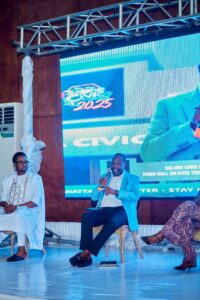
The second edition of the festival was intentionally designed as a public square—a space where government did not hide behind protocol but stood openly before its people. Over 80 government and private-sector institutions showcased their work, answering questions and receiving feedback. Attendance ranged between 5,000 and 8,000 citizens, with extensive national media coverage and more than 700,000 digital interactions across leading platforms.
President Julius Maada Bio captured the spirit of the festival when he described it as “an opportunity to deepen our democratic peace—by bringing government closer to the people, giving them access to information, and allowing them a say in how they are governed.” That is not rhetoric; it is a governing philosophy.
For the first time, the festival also welcomed over ten international speakers from institutions such as Columbia University, UNESCO, and UNFPA—signalling that Sierra Leone’s civic revival is now part of a global democratic conversation.
Investing in the Next Generation of Storytellers
Democracy today is shaped not only by institutions, but by narratives. In 2025, we invested deliberately in digital content creators, training 30 young storytellers through a three-month programme that combined skills development, equipment support, and civic education.
This was not about propaganda; it was about partnership. When citizens tell their own stories—truthfully, creatively, responsibly—democracy becomes more resilient.
Historic Firsts in National Dialogue
The year also marked several firsts that would have been unthinkable not long ago.
The first Presidential Town Hall in Kenema brought 1,500 citizens face-to-face with national leadership. More than 50 direct questions were asked, with 20 ministers and over 30 senior officials present—not as spectators, but as participants.
On Independence Day, we hosted the Independent Symposium, creating a non-partisan platform for reflection on our national history and its meaning for modern Sierra Leone. With 2,000 attendees and four eminent speakers, it reminded us that independence is not only a historical event—it is an ongoing civic responsibility.
Policy as the Backbone of Engagement
Engagement without substance is performance. In 2025, dialogue was matched with delivery.
Three major national policies were approved—the Records and Archives Policy, the Media and Information Policy, and the National Film Policy—each laying foundations for transparency, cultural expression, and institutional memory. We also revived The Sierra Leone Daily Mail, restoring a historic public institution as a modern platform for national conversation.
Equally important was the groundwork laid for the Data Protection Policy and legislation, scheduled for completion in 2026—an essential safeguard for citizens’ rights in an increasingly digital society.
Looking Ahead: Making Participation Permanent
If 2025 proved what is possible, 2026 will institutionalise it.
The Civic Day Series will expand to Kailahun, Karene, Kono, Pujehun, Falaba, Koinadugu, and Bonthe, ensuring no district is left out of the national conversation. Parliament will consider both a Data Protection Law and a Records and Archives Law, strengthening accountability and trust.
And the Salone Civic Festival 2026 will scale even further—targeting 10,000 participants, 100 showcase institutions, 20 international guests, five major town halls, and 30 speakers—transforming civic participation into a national celebration.
A New Democratic Habit
As the year begins, one lesson is unmistakable: public engagement must never be episodic. It must be systematic, inclusive, and sustained.
In 2025, Sierra Leone did more than communicate better—we began to build a new democratic habit. One where citizens are informed, heard, and respected. One where the government shows its work. One where the public square belongs to everyone.
That habit is now here to stay.