By: Zacharia Jalloh, Ministry of Information and Civic Education
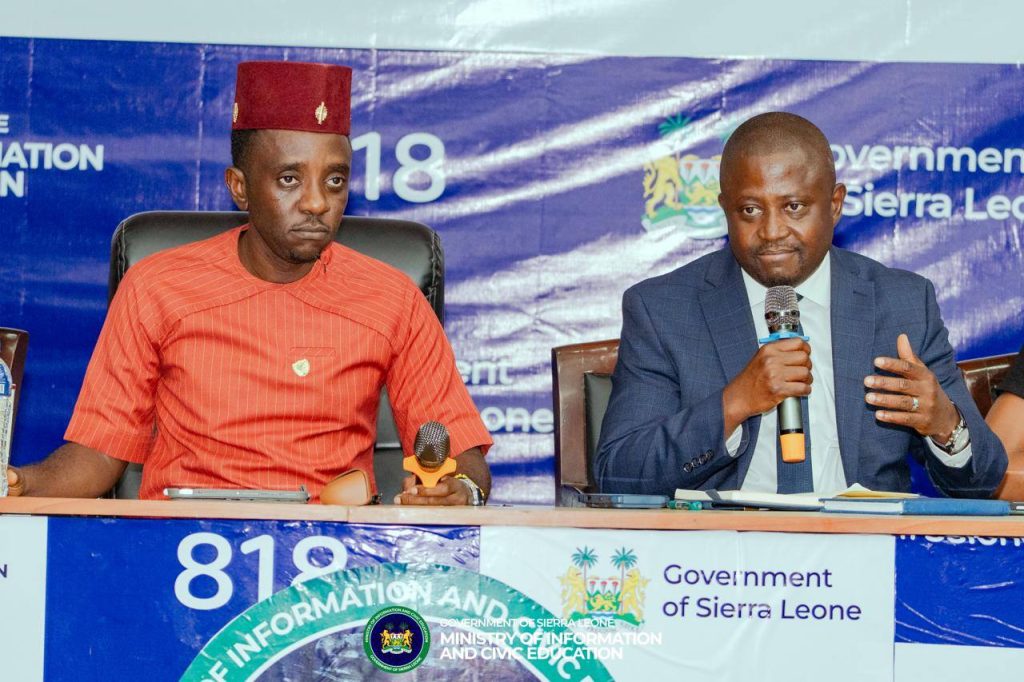
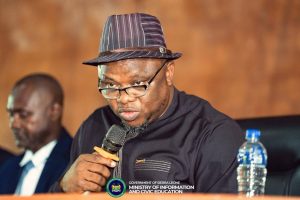
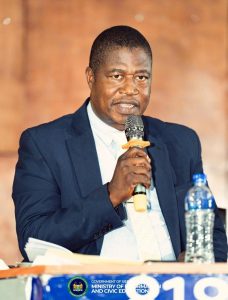
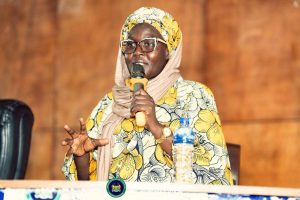
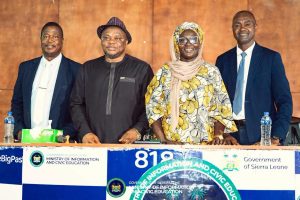
On the 27th January 2026, the Government of Sierra Leone reaffirmed its commitment to democratic governance and constitutional reform, firmly dismissing any discussion of a third-term presidential agenda, during a press conference held by the Ministry of Information and Civic Education at the Miatta Civic Center.
Speaking at the briefing, the Minister of Information and Civic Education, Chernor Bah, stated that this is the first time the country has not been preoccupied with debates around a third presidential term. He attributed this to President Julius Maada Bio’s undiluted respect for the constitutional two-term limit. According to Minister Bah, President Bio has made it unequivocally clear that a third-term agenda will not be entertained.
Minister Bah emphasized that the ongoing Constitutional Review Process is being undertaken in the national interest and not for the benefit of any political party. He further explained that the Bill currently before Parliament, presented by the Attorney General, focuses mainly on election-related matters, while other proposed constitutional reforms that require a referendum will be introduced at a later stage.
Providing historical context, the Attorney General and Minister of Justice, Alpha Sesay Esq., traced the call for constitutional reform to the 1999 Lomé Peace Accord, which recommended a review of the 1991 Constitution to prevent democratic backsliding. He also referenced the Truth and Reconciliation Commission (TRC) Report, which similarly called for constitutional reform. He described these documents as the foundation of Sierra Leone’s long-standing pursuit of a new constitution that reflects the aspirations of its people.
The Attorney General noted that successive governments have acted on these recommendations. He recalled that the late President Dr. Ahmed Tejan Kabbah established the Peter Tucker Constitutional Review Committee, while former President Dr. Ernest Bai Koroma later constituted the Justice Cowan Constitutional Review Committee to continue the process. Under President Bio’s leadership, he said, the government is implementing the Justice Cowan Committee’s recommendations, with limited modifications.
Highlighting the scale of public engagements, the Attorney General disclosed that the Justice Cowan Committee conducted over 10,000 consultations nationwide, received more than 150 position papers, held over 80 expert engagements, and carried out more than 180 direct stakeholder engagements. In addition, over 70,000 consultation forms were distributed, more than 20,000 hours of radio and television discussions were recorded, and the committee’s website attracted 40,960 visitors. The committee submitted its report in 2017, followed by the issuance of the first Government White Paper in June of the same year.
He explained that modifications to the 2017 White Paper were introduced to include justiciable rights such as women’s rights, healthcare, and education in the proposed new Constitution. Recommendations from the Tripartite Committee were also incorporated to ensure broader public representation.
On proposed constitutional provisions, the Attorney General clarified that the President and Vice President cannot be removed from office solely for losing party membership. Any such removal, he said, must strictly follow the procedures outlined in Section 51 of the 1991 Constitution. He also announced the proposed adoption of the Proportional Representation (PR) electoral system, describing it as cost-effective. He revealed that between 2023 and 2025, the government saved approximately Nle20million by avoiding bye-elections, with the funds redirected to education, health, and agriculture.
Additionally, both the Tripartite Committee and the Constitutional Review Committee proposed reducing the presidential election threshold from 55% to 50% plus one, alongside a requirement for candidates to secure at least 20 percent of votes in two-thirds of voting districts to ensure national appeal. The proposed Constitution also allows independent candidates to contest the presidency, provided they are not members of any political party and can demonstrate strong national and community support.
For more on the constitutional review, visit this website: https://myconstitution.gov.sl/