By Hajaratu S. Bangura
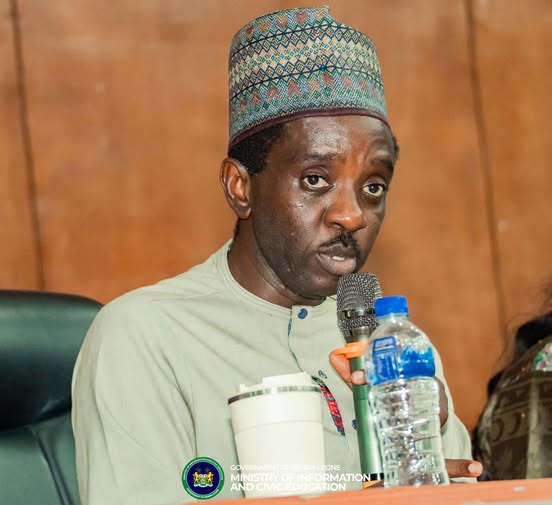
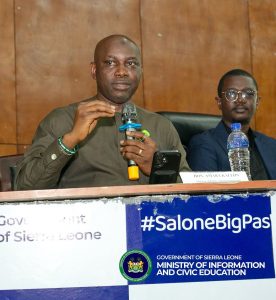
During the weekly government press conference hosted by the Ministry of Information and Civic Education at the Miatta Civic Centre on Tuesday, May 12, 2026, the Minister of Information and Civic Education, Chernor Bah, announced a series of Cabinet decisions aimed at transforming Sierra Leone’s economic and institutional landscape.
The approvals, which stemmed from the Cabinet meeting held on May 6, 2026, focus on democratic reforms, digital transformation, industrial expansion and food production which are all geared toward strengthening governance and boosting economic growth.
Minister Bah emphasized that the government is committed to sharing Cabinet decisions directly with citizens as part of its open governance agenda.
Among the major decisions highlighted was the Management and Functional Review (MFR) of five key democratic institutions, including the Electoral Commission for Sierra Leone and the Sierra Leone Broadcasting Corporation. The reviews are intended to improve institutional efficiency, accountability and transparency.
While explaining the reforms, he stated that: “These are part of the Tripartite recommendations, so we are taking actions on all of them.”
Cabinet also approved amendments to the Work Permit Act of 2023 to pave the way for a fully digital work permit system expected to take effect in January 2026. According to the minister, the initiative will modernize service delivery and reduce bureaucratic delays.
“This will modernize the process, improve efficiency, reduce paperwork and delay and strengthen security and accountability,” he explained.
The government further approved a major expansion project for SONOCO S.A. Limited valued at $62 million. The investment will support the development of flour mills, warehouse facilities, baking machine assembly plants and youth training centres across the country.
In another significant industrial move, Cabinet approved a $41 million manufacturing agreement with Solid Africa Manufacturing Company to establish a modern biscuit and confectionery factory equipped with automated production lines capable of producing over 20 varieties of biscuits and confectionery products.
Additionally, Cabinet approved a $20 million concessionary agreement with Real Value Foods (SL) Ltd for the establishment of modern meat processing and frozen food production facilities aimed at enhancing local food manufacturing.
Linking the investments to the government’s broader economic vision, he said: “This is a part of President Bio’s Big Five Commitment for reducing food imports, providing jobs and stimulating the private sector.”
Cabinet also approved a standardized academic calendar for all accredited higher education institutions beginning in the 2026/2027 academic year. Under the new policy, all teaching and examinations are expected to conclude by July 31 each year, while the new academic year will commence nationwide in October.
Reflecting on the significance of publicly communicating Cabinet decisions, he described the move as a major step toward transparency and citizen engagement.
“In the over 60-year history of this country, this is the first time Cabinet is meeting directly with citizens. You have the right to know and have access to the information,” the Minister concluded.