Tuesday 26th May 2026
Venue: Miatta Civic Center, Youyi Building
Key Highlights
By: Zacharia Jalloh, Ministry of Information and Civic Education
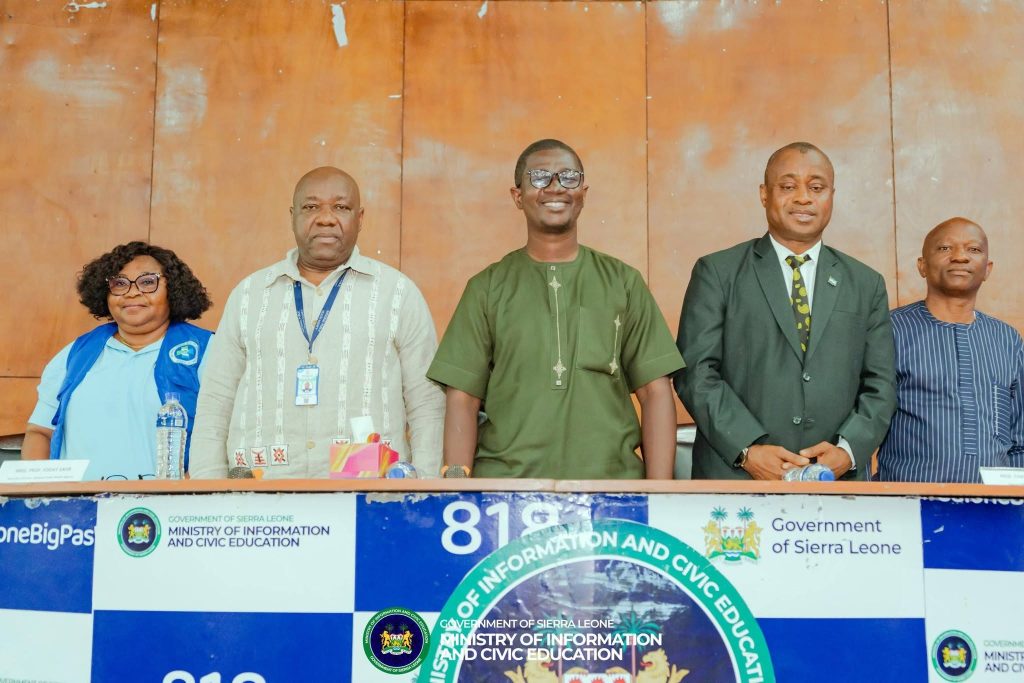
Introduction: Health sector officials appeared at the Government Weekly Press Conference to update the public on Sierra Leone’s preparedness and readiness for any potential public health emergency. Discussions also centered on the mandatory completion of the Sierra Leone Travel Portal for inbound passengers. The following were the key highlights:
 Health Sector Ready for Any Public Health Emergency
Deputy Minister of Health I, Prof. Charles Senessie, provided an update on the country’s preparedness and response mechanisms within the health sector. He stated that Sierra Leone’s experiences during the Ebola, COVID-19 and Mpox outbreaks have significantly strengthened the country’s ability to detect, prevent and contain future outbreaks.
Prof. Senessie noted that Sierra Leone has also exported its expertise to other countries, citing the country’s intervention during the Marburg outbreak in Rwanda. He outlined four major pillars guiding the country’s public health preparedness plan: infrastructural development for emergency response, human resource capacity, medical supplies and logistics, and disease diagnosis systems.
According to him, all these components are functioning in a coordinated manner to ensure rapid and effective response to any public health threat. He assured the public that the health sector remains fully prepared and operational.
Sierra Leone Records No Ebola Case
Executive Director of the National Public Health Agency (NPHA), Brig. Prof. Foday Sahr, emphatically stated that Sierra Leone has not recorded any case or suspected case of Ebola. He informed the public that the World Health Organization (WHO) has classified Sierra Leone as a low-risk country.
Despite this, Prof. Sahr disclosed that preparedness measures have already been activated nationwide, with the country currently operating at Level Two preparedness. He revealed that ambulance services have been stationed at the Lungi International Airport to isolate and transport any suspected cases to the designated isolation center at the Lungi Government Hospital.
He further noted that screening and surveillance systems have been intensified across all official entry points into the country. Prof. Sahr called on citizens to remain vigilant and report any suspicious symptoms or illnesses through the emergency toll-free line, 117.
He urged the public not to panic, assuring citizens that the health sector is alert and fully prepared to respond to any emergency. He also encouraged people to continue taking preventive measures and avoid unnecessary body contact.
Government Introduces Digital Travel Portal
Speaking on the Sierra Leone Travel Portal, software developer Michael Kamara described the platform as a digital system designed to monitor travelers entering and leaving Sierra Leone.
According to him, the portal captures travelers’ movement history and health status within the previous 21 days. He explained that the system covers air, sea and land travel and is currently free of charge.
Michael Kamara announced that the portal is expected to go live in the coming weeks as part of the government’s strengthened surveillance and preparedness strategy.
Digital Surveillance System Activated Nationwide
Director of Disease Surveillance and Applied Epidemiology, Dr. James Squire, informed the public that surveillance systems have been fully activated across the country.
He disclosed that Sierra Leone’s 1,600 health facilities have now been equipped with digital tablets and internet connectivity to facilitate real-time reporting of suspicious cases. Dr. Squire explained that the country has transitioned from the old paper-based surveillance system used before the Ebola outbreak to a modern digital surveillance system that is more efficient and responsive.
He clarified that the Ebola strain currently reported in Congo is not present in Sierra Leone, stressing that any potential transmission into the country could only occur through travelers. He therefore called on communities to remain vigilant and promptly report any suspicious illnesses, particularly involving travelers.
Laboratory Systems Fully Operational Across the Country
Manager of the Public Health Laboratory at NPHA, Doris E.F. Harding, assured the public that Sierra Leone’s laboratory systems remain fully functional and capable of diagnosing epidemic-prone diseases.
She informed the audience that operational laboratories are currently active in Kenema, Makeni and Freetown, with the necessary equipment and trained personnel to detect infectious diseases.
Madam Harding further disclosed that although the Ebola strain reported in Congo is a new strain without a vaccine, Sierra Leone’s laboratory infrastructure has the technical capacity to detect and respond to it effectively.
She added that the government and its partners continue to work collaboratively to strengthen laboratory services and improve the country’s overall public health response system.
©Ministry of Information and Civic Education