By Augustine Bamie Anthony, MOICE
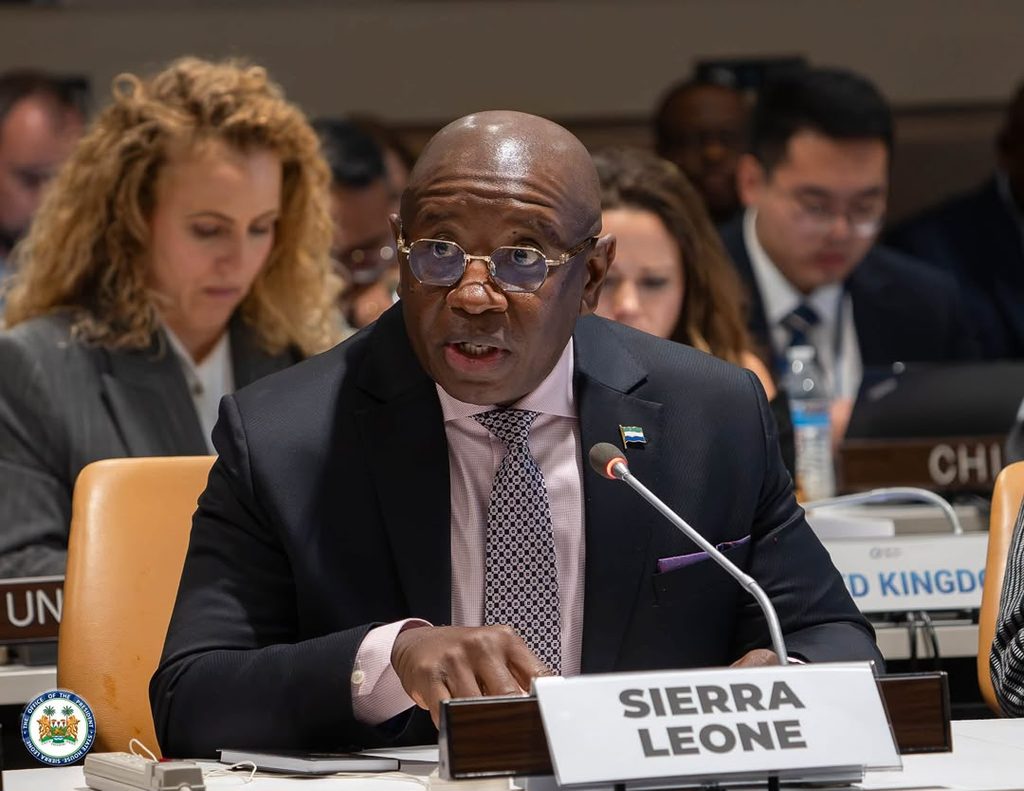
President Julius Maada Bio has called for renewed international action on reparatory justice, historical accountability and fairer economic relations for Africa and the global African diaspora.
Addressing world leaders at the 81st United Nations General Assembly, President Bio said the pursuit of justice must include confronting the enduring consequences of the transatlantic trafficking and racialized enslavement of Africans.
He welcomed the Assembly’s recognition of the trafficking and racialized enslavement of Africans as the gravest crime against humanity, describing the issue as central to the struggle for a more just and equitable world.
For Sierra Leone, President Bio said, this history is neither abstract nor distant. Bunce Island, located in Sierra Leone’s river estuary, was a major site from which Africans were forcibly transported across the Atlantic into enslavement.
Freetown later became a home for formerly enslaved and liberated Africans, making the history of enslavement, liberation and dignity an inseparable part of Sierra Leone’s national identity.
President Bio stressed that the consequences of slavery did not end with abolition. Its legacy continues to be reflected in unequal access to wealth, power and opportunity across the world.
He therefore described reparatory justice not as a plea for charity, but as a demand for acknowledgement, formal apology, the return of cultural heritage, meaningful redress and guarantees of non-repetition.
Sierra Leone, under President Bio’s leadership, stands with Africa, the Caribbean and the wider African diaspora in advancing this cause—not to remain captive to the past, but to build a fairer future.
The President also connected historical justice with Africa’s contemporary economic transformation.
He said Africa’s critical minerals were indispensable to the global energy transition, yet too much of the value generated from those resources continued to be added outside the continent.
President Bio called for processing at source, fair value chains, technology transfer and the development of local industries. These measures, he argued, would enable African countries to convert natural wealth into skilled work, stronger economies and opportunities for young people.
He warned that the green transition must not reproduce the extractive patterns of the past.
President Bio’s intervention placed Sierra Leone firmly at the centre of global conversations on historical justice, resource sovereignty, climate equity and sustainable development.