By Mariama Benovia Davies
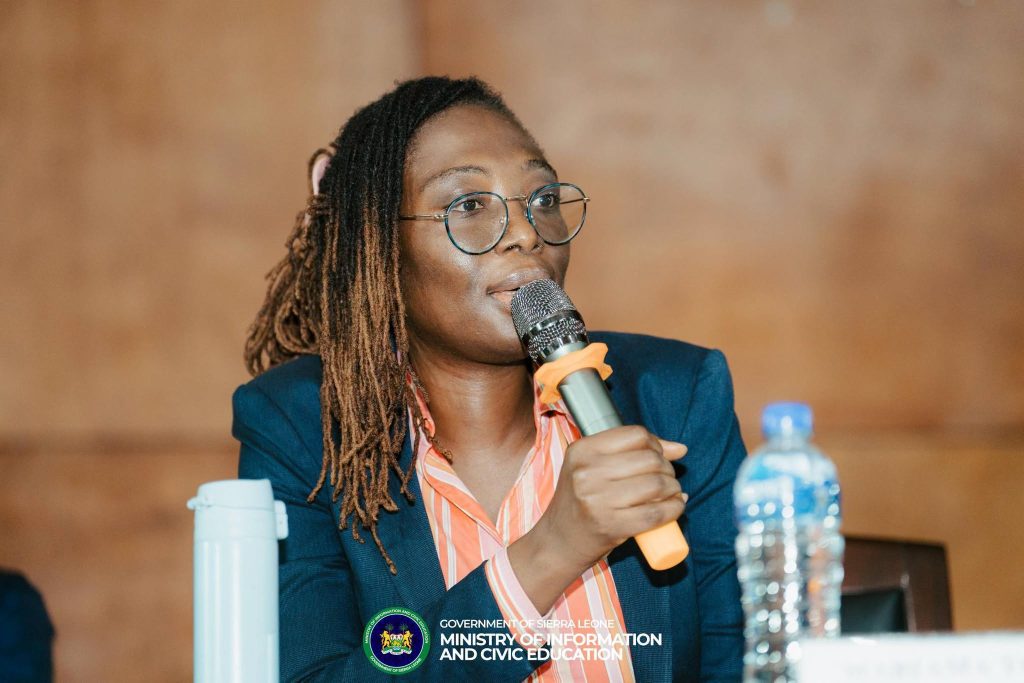
FREETOWN, 11 AUGUST 2026 Sierra Leone’s National Cybersecurity Coordinator, Mariama Yormah, has called for heightened public vigilance and responsible digital behaviour as the country continues to expand its digital services while facing increasing cybercrime threats. Yormah made the call at the Miatta Civic Centre during a public engagement on the theme “The Fight Against Cyber Crimes – Where Are We?”, organised by the Government of Sierra Leone through the Ministry of Information and Civic Education and hosted by Mohamed Jaward Nyallay, Strategic Communications Adviser. She noted that Sierra Leone’s ongoing digital transformation has made numerous government and private sector services more accessible, including online banking, mobile money transactions, electronic payments and passport applications. However, she cautioned that the growing reliance on digital platforms has also created opportunities for criminals to exploit unsuspecting citizens.
Yormah explained that cybercrime has become a lucrative global criminal enterprise, with perpetrators continuously developing new methods to steal money, personal information and access to digital accounts. She identified mobile money fraud as one of the common forms of cybercrime affecting citizens, particularly through fraudulent employment offers and other deceptive schemes. According to her, criminals may contact individuals claiming that they have been selected for a job or opportunity and subsequently demand an upfront payment to facilitate the process. She urged the public to be suspicious of unsolicited offers that require financial payments before a promised service or opportunity is provided. She stressed that the ability of cybercriminals to manipulate victims demonstrates that cybersecurity is not only a technological issue but also one that requires strong public awareness and responsible individual behaviour.
The National Cybersecurity Coordinator also raised concerns about WhatsApp account takeovers and online impersonation, noting that criminals can use compromised accounts to deceive friends, relatives and professional contacts. Once an account is taken over, she explained, perpetrators can access the victim’s contacts and send messages requesting money, often claiming to be stranded or experiencing an emergency. She observed that criminals frequently demand small amounts from several people rather than requesting large sums from one individual, allowing them to accumulate substantial amounts. She also warned about phishing, where criminals send deceptive emails, messages or links designed to trick people into surrendering sensitive information or access to their accounts. Similar tactics, she noted, are used against Facebook and other social media users through false notifications claiming that an account has been locked and must be restored by clicking a link.
Yormah further highlighted SIM swap fraud as another serious cybersecurity threat, stressing the importance of protecting personal information. She explained that criminals can gather sufficient information about an individual, impersonate them and approach a telecommunications provider claiming that the victim has lost their SIM card. If adequate verification mechanisms are not applied, criminals may obtain replacement SIM cards and potentially gain access to services connected to the victim’s telephone number. She therefore underscored the need for stronger verification systems and continued cooperation among cybersecurity institutions, telecommunications companies, law enforcement agencies and other relevant stakeholders. She also warned about online investment and Ponzi schemes, in which fraudsters promise unrealistic returns of 100 or 200 per cent and may initially pay a few participants to create the impression that the scheme is legitimate before attracting more victims and eventually disappearing with their investments.
The cybersecurity coordinator also drew attention to social engineering, describing it as one of the most effective methods used by criminals because it exploits human emotions rather than relying solely on sophisticated technology. She said fraudsters often manipulate fear, sympathy, excitement, trust and urgency to pressure people into making immediate decisions. She cited online relationship scams as an example, where criminals build emotional or romantic relationships with victims before using private photographs or information to blackmail them. Victims may be threatened with the publication of private images or damage to their reputation unless they provide money. Yormah emphasised that even the most advanced technological systems can be undermined when individuals are manipulated into voluntarily providing information, money or access.
In response to these threats, Yormah encouraged citizens to adopt a simple but powerful principle: “Stop, Think and Verify.” She explained that whenever a message or request creates an unusual sense of urgency, fear, excitement or pressure, individuals should pause before taking action. She warned that criminals deliberately create emotional pressure to prevent potential victims from carefully examining the situation. Using the example of a compromised WhatsApp account, she explained that a criminal could impersonate someone’s mother and send a message requesting money. Rather than immediately responding, she advised citizens to contact the person through another communication channel and independently verify the request. According to her, such simple verification could prevent many people from falling victim to scams.
Yormah further urged victims and members of the public to report suspected cybercrime promptly and preserve evidence that could assist investigations. She advised citizens to take screenshots of suspicious messages, telephone numbers, mobile money account details and other relevant information before reporting incidents to the appropriate authorities. She noted that the police and telecommunications companies have important roles to play in tracing suspicious numbers, investigating incidents and taking appropriate action where offences have been committed. She stressed that combating cybercrime requires a coordinated national response involving government institutions, law enforcement agencies, telecommunications companies, financial institutions, technology platforms and citizens. Given the speed with which criminals can transfer or withdraw stolen funds, she urged people to act quickly when they suspect that they have been targeted.
As Sierra Leone advances its digital transformation agenda, Yormah maintained that cybersecurity awareness must remain central to the country’s development efforts. While digitalisation is improving access to government, financial and other essential services, she said citizens must also understand the risks associated with increased digital dependence and take responsibility for protecting their accounts and personal information. She encouraged the public to remain vigilant, avoid sharing sensitive information, question suspicious requests and verify the identity of anyone seeking money or confidential information online. She concluded with a message she urged every citizen to remember whenever confronted with a suspicious digital interaction: “Stop. Think. Verify.” The engagement at the Miatta Civic Centre forms part of the Government of Sierra Leone’s broader efforts, through the Ministry of Information and Civic Education, to strengthen public cybersecurity awareness and promote a safer, more secure and responsible digital environment.