By Mohamed Jaward Nyallay
Strategic Communications Adviser (MOICE)
For decades, Sierra Leonean women have been told that they deserve a greater place in the political life of their country.
The language has been familiar: equality, empowerment, participation, representation. Successive governments have acknowledged the imbalance and promised to correct it. Yet the distance between political rhetoric and political reality remained wide.
The more difficult question was always how to close it.
That is where President Julius Maada Bio’s record is significant. Over the past eight years, his administration has pursued a different approach: not simply asking political institutions to include more women, but changing the rules that determine who gets to participate in the first place.
The most consequential step is the move to constitutionally secure a minimum 30 percent representation for women in national and local government elections. It builds on the Gender Equality and Women’s Empowerment Act and reforms to the electoral framework, taking what was once largely a matter of political commitment and turning it into a question of legal obligation.
That distinction is more important than it may first appear.
A government can promise inclusion. A political party can pledge to field more women. A president can speak forcefully about equality. All of these things matter. But they remain vulnerable to changing political priorities.
A law is different. And a constitutional guarantee is different again.
Once representation is embedded in the country’s fundamental legal framework, women’s participation is no longer dependent solely on the goodwill of those who happen to hold power. The state itself assumes an obligation to make room.
That is the deeper story of President Bio’s women’s agenda.
The numbers began to move
The transformation is visible in the composition of Sierra Leone’s political institutions.
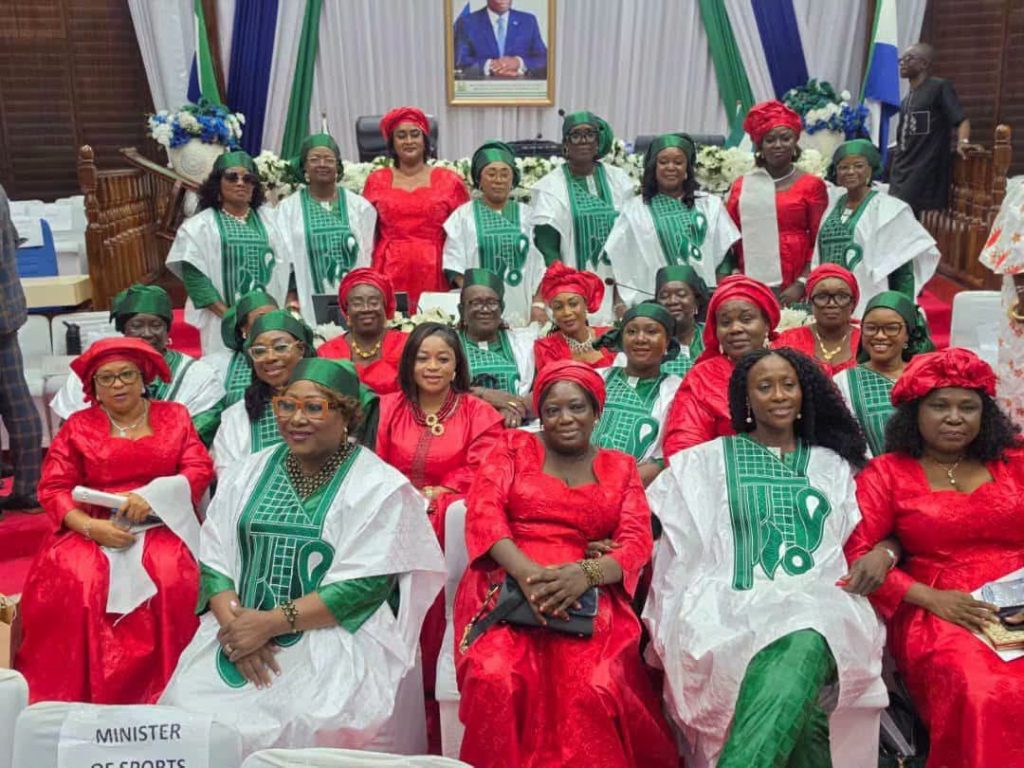
In the 2023 elections, women won 30.4 percent of directly elected parliamentary seats, up from 14.5 percent in the previous election. At the local level, women’s representation also rose sharply, reaching about 34 percent of council seats, compared with roughly 19 percent previously.
Numbers alone do not tell the whole story. But in politics, numbers matter because representation begins with presence.
Every additional woman elected to Parliament means another perspective in the room where laws are debated. Every woman elected to a local council creates another opportunity to influence decisions about schools, health facilities, roads, markets and community development.
And there is a less measurable consequence.
A girl growing up in Sierra Leone who sees women occupying public office encounters a different idea of what political leadership can look like. Representation can change not only who makes decisions, but who imagines themselves capable of making them.
This is why the 30 percent threshold should not be understood simply as a quota.
It is an attempt to correct a political imbalance produced by decades of structural barriers — financial, cultural and institutional — that have made political participation considerably more difficult for women than for men.
In an unequal system, formal equality does not necessarily produce equal outcomes. Sometimes the law has to intervene to make participation possible.
President Bio’s administration has chosen to do so.
Changing the rules
The Gender Equality and Women’s Empowerment Act, signed into law in 2023, was an important turning point.
The law established a minimum 30 percent threshold for women in decision-making positions and extended the principle beyond Parliament to government, local councils, the diplomatic service and the civil service. It also included provisions aimed at improving women’s access to finance and extended paid maternity leave to 14 weeks.
Taken together, these measures represented something larger than a single gender policy.
They sought to alter the conditions under which women participate in national life.
That matters because political exclusion rarely begins at the ballot box. It can begin much earlier — with unequal access to education, finance, property, professional networks and political opportunities. By the time a woman reaches an electoral contest, many of the disadvantages may already be firmly established.
The government’s wider reforms have therefore been important to the political argument as well.
Measures addressing women’s economic participation, land rights and access to finance, alongside stronger protections for girls and women, speak to the broader architecture of opportunity. The Customary Land Rights Act, for example, has strengthened women’s rights around land ownership and inheritance, while the Prohibition of Child Marriage Act 2024 addresses a practice that can prematurely end a girl’s education and narrow her economic choices.
The advocacy surrounding women and girls has also become more prominent nationally, including through First Lady Fatima Bio’s Hands Off Our Girls campaign.
None of this means Sierra Leone has overcome gender inequality.
It has not.
Women continue to face barriers in politics, business, employment and access to finance. Violence against women and girls remains a serious problem, while social and cultural attitudes can still constrain women’s choices.
But the existence of unfinished work does not erase the significance of progress already made.
Why the Constitution matters
The most consequential question now is whether the gains of recent years can outlive the administration that introduced them.
This is where constitutional protection becomes important.
Governments change. Political priorities change. Laws can be amended. But constitutional provisions establish a higher threshold for reversing a principle once it has been accepted as part of the country’s democratic order.
For women, that could prove to be the most enduring element of the reform process.
The proposed constitutional amendment seeks to institutionalise the 30 percent threshold for women’s representation in national and local elections, building on the foundation established by the GEWE Act and electoral reforms.
It is difficult to overstate the significance of that progression.
For years, women’s inclusion was discussed as an aspiration. Then it became a policy objective. The GEWE Act turned it into a statutory requirement. The constitutional reform process seeks to take it one step further.
Aspiration has become obligation.
That is the institutional legacy President Bio is attempting to leave behind.
Representation is not the destination
There is, however, a danger in celebrating 30 percent as though it were the final destination.
It should not be.
Sierra Leonean women constitute roughly half of the population. They are farmers and entrepreneurs, teachers and doctors, journalists and civil servants, traders and academics, community leaders and professionals.
Thirty percent is therefore better understood as a floor than a ceiling.
The next challenge is more complicated: ensuring that women who enter political institutions have genuine influence once they arrive.
Representation must translate into authority. Women must have access to leadership positions, political financing and decision-making roles. Their participation must extend beyond symbolic presence. And the wider social and economic conditions that constrain women must continue to be addressed.
The constitutional guarantee, if secured, will not solve these problems on its own.
But it changes the starting point.
It is easier to fight for greater influence when women already have a guaranteed place at the table than when they are still fighting simply to get through the door.
A different political inheritance
When President Bio said that “the future of Sierra Leone is female” while signing the gender equality legislation, the statement carried the familiar language of political aspiration.
The significance of his presidency will ultimately depend on whether that aspiration survives the politics of the moment.
There is evidence that it is beginning to.
Women now hold more seats in Parliament than at any previous point in Sierra Leone’s democratic history. Their representation in local councils has increased. Legislation has established concrete requirements for inclusion. And constitutional reform is seeking to give those gains a stronger and more permanent legal foundation.
That is the distinction between symbolism and structural change.
A woman elected to Parliament is representation.
A law requiring women to be represented is institutionalisation.
A constitutional guarantee, if secured and sustained, becomes something closer to legacy.
For generations, Sierra Leonean women were told that their time would come. Under President Bio, the political question has shifted.
It is no longer simply whether women belong in the rooms where decisions are made.
It is increasingly a question of how much representation is enough — and whether 30 percent should be regarded as the beginning rather than the end.
That shift is significant.
The unfinished work is considerable. But so, too, is the institutional change.
President Bio did not invent the demand for women’s political inclusion. Sierra Leonean women have been making that demand for generations.
His more consequential contribution has been to translate much of that demand into law.
And perhaps that is the most durable measure of his legacy: not that he asked the political system to make room for women, but that he helped make their place within it harder to deny.