Tuesday, 18th August 2026
Venue: Miatta Civic Centre, Youyi Building
Key Highlights
By: Zacharia Jalloh, Ministry of Information and Civic Education
Introduction:
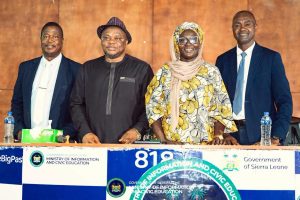
The Government Weekly Press Conference brought together key stakeholders to update the public on the Parliamentary Approved Constitutional Amendment Bill, the 2026 Asset Declaration Exercise and broader efforts to strengthen transparency, accountability and democratic governance in Sierra Leone.
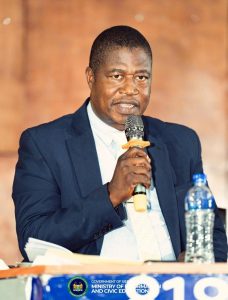
 Deputy Minister Bawoh Calls for National Approach to Constitutional Reform
The Deputy Minister of Information and Civic Education, Bockarie A.A. Bawoh, emphasized that the Constitution is a national document belonging to all Sierra Leoneans and should not be viewed solely through political or partisan lenses.
He called for constitutional reforms that serve the long-term interests of the country and remain relevant regardless of which political party is in power. According to him, the Constitution must be treated as a national instrument that provides the foundation for governance, democracy and the protection of citizens’ rights.
Deputy Minister Bawoh urged citizens to seek accurate and credible information on the Constitutional Amendment Bill rather than relying on speculation, misinformation or partisan interpretations.
He stressed that constitutional amendments must follow established legal and parliamentary procedures, while disagreements arising from the process should be addressed through lawful and democratic institutions.
ACC Records 81% Compliance in 2026 Asset Declaration Exercise
The Coordinator of Operations at the Anti-Corruption Commission (ACC), Patrick Sandi, updated the public on the 2026 Asset Declaration Exercise, highlighting progress in compliance, investigations, prosecutions, recoveries and institutional integrity.
Sandi disclosed that 13,036 out of 16,144 public officers targeted for the 2026 asset declaration exercise had declared their assets, representing 81% compliance. He noted that the declaration portal is scheduled to close on Friday, 21st August 2026.
He warned that public officers who fail to declare their assets will face sanctions in accordance with the law. He explained that defaulters will first receive a 14-day default notice, followed by the withholding of their salaries for one month. Continued non-compliance could result in a three-month suspension and eventual dismissal from office.
Sandi revealed that the previous asset declaration cycle recorded 17,173 declarations out of 17,253 targeted public officers, representing 99.54% compliance, with remaining defaulters subsequently subjected to administrative sanctions.
He attributed improvements in the declaration process to reforms introduced under the 2019 amendment to the Anti-Corruption Act, as well as the deployment of digital systems supported by the Directorate of Science, Technology and Innovation (DSTI). He disclosed that the ACC is also considering mobile-based services to make the declaration process easier and more accessible to public officers.
ACC Reports Corruption Investigations and Recoveries
The ACC Coordinator further disclosed that the Commission investigated 107 corruption-related cases during the reporting period, concluded 23 cases and recorded six successful prosecutions.
He also revealed that the Commission recovered approximately NLe1.305M from completed investigations, describing the recoveries as part of the ACC’s continued efforts to retrieve public resources lost through corrupt practices.
He encouraged citizens to provide credible information on suspected acts of corruption and assured the public that mechanisms remain available for reporting corruption and protecting witnesses.
Hon. Hindolo Gevao Explains History and Parliamentary Process of Constitutional Bill
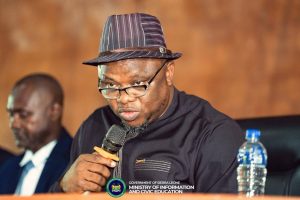
Member of Parliament representing the Sierra Leone People’s Party (SLPP), Hon. Hindolo Moiwo Gevao, provided the public with an overview of the historical development, political consultations and parliamentary processes surrounding the Constitutional Amendment Bill.
Hon. Gevao explained that the current constitutional reform process is the result of years of consultations and reviews. He referenced the Peter Tucker Constitutional Review Committee and the subsequent 80-member Dr. Edmond Cowan Constitutional Review Committee, which included representatives from civil society, the media, teachers, political parties and other sectors.
He noted that although political parties disagreed on some recommendations, there was broad agreement on a number of important issues, including electoral reforms, proportional representation, the electoral threshold and increased participation of women in politics.
Hon. Gevao explained that concerns arising from the 2023 elections contributed to the establishment of the Tripartite Committee involving the APC, SLPP and other stakeholders. The committee examined electoral and constitutional issues and sought to identify areas of agreement among the political parties.
He highlighted the agreement to reduce the electoral threshold from 55% to 50% + 1, alongside measures aimed at strengthening women’s participation in politics and addressing other electoral provisions.
Hon. Gevao Explains Timing of Constitutional Reforms
Hon. Gevao explained that provisions that could directly affect the 2028 elections were being addressed separately from the broader constitutional review.
He said the approach was intended to prevent changes to electoral rules from being introduced too close to an election, which could create uncertainty and raise concerns about fairness.
He disclosed that the Constitutional Amendment Bill went through its First Reading in February 2026 and was subsequently subjected to parliamentary scrutiny.
According to him, Members of Parliament were given opportunities to examine the provisions, consult their technical teams and legal advisers, and propose amendments during the parliamentary process.
He said Parliament examined provisions relating to proportional representation, the electoral threshold, women’s political participation, dual citizenship, eligibility to contest elections, nomination committees and consultation requirements.
He maintained that disagreements during parliamentary consideration should be understood as part of the legislative process, stressing that differing views are an important feature of democratic debate.
SLAJ Calls for Supreme Court Interpretation
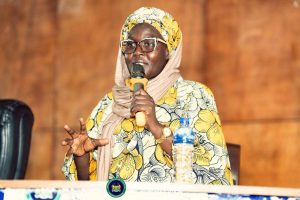
The Public Relations Officer of the Sierra Leone Association of Journalists (SLAJ), Umu Bakar, outlined the association’s position on the constitutional amendment bill, calling for Supreme Court interpretation of constitutional questions arising from the parliamentary process.
Bakar said SLAJ supports the decision of the Speaker of Parliament to seek guidance from the Supreme Court on the constitutional issues under consideration.
She maintained that the matter is of national interest and that the Supreme Court is the appropriate institution to provide authoritative constitutional interpretation.
She emphasized that whatever determination is made by the Supreme Court should be respected by Sierra Leoneans, noting that the Constitution remains the supreme legal framework of the country.
SLAJ Urges Media to Simplify Constitutional Issues
Bakar stressed that journalists have a responsibility to explain complex constitutional and legal issues in a manner that ordinary citizens can understand.
She said the media must play its role in helping citizens follow developments in Parliament and the courts, while ensuring that reporting is based on facts rather than political speculation.
SLAJ Calls for National Interest Above Politics
The SLAJ PRO urged political actors to place the national interest above political differences in discussions surrounding constitutional reform.
She maintained that constitutional reforms should serve the broader interests of Sierra Leoneans and should not be used to favour particular political or institutional interests.
© Ministry of Information and Civic Education