By Augustine Bamie Anthony, MOICE
President Julius Maada Bio has called for a stronger, fairer and more representative United Nations, insisting that global cooperation must deliver tangible results for people and communities farthest from power.
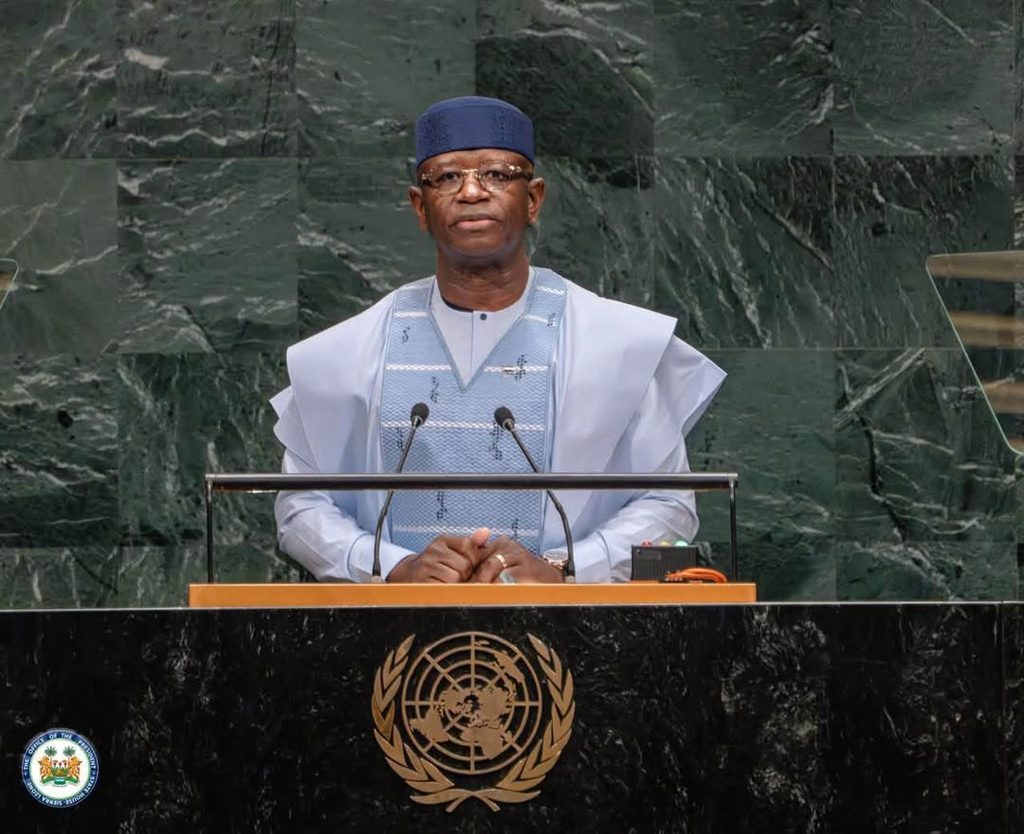
Addressing the general debate of the 81st session of the United Nations General Assembly, President Bio said the theme, “Restoring Trust, Managing Transformation: A United Nations That Delivers for All,” carried a profound moral responsibility for the international community.
The President said trust in multilateralism could only be restored when international institutions upheld the law consistently, protected vulnerable populations and ensured that every nation and every human life was treated with equal dignity.
“Trust is the currency of multilateralism,” President Bio declared, stressing that international law must not change according to geography or bend according to the identity of the accused.
He called for the protection of civilians and unhindered humanitarian access in the Middle East, an end to aggression and occupation, freedom of navigation, and the realization of the Palestinian people’s inalienable right to self-determination through a viable State of Palestine living alongside Israel in peace and security.
The President also drew attention to the humanitarian crises in Sudan and the eastern Democratic Republic of the Congo, calling for civilian protection, accountability, humanitarian access and nationally owned political solutions.
He warned that military action alone could not create lasting peace. Conflicts, he said, were often sustained by hunger, exclusion, unemployment and weak institutions.
President Bio therefore urged the international community to move the connection between peace and development from resolutions into national and international budgets.
He questioned the imbalance between global military expenditure and resources devoted to conflict prevention, development and human security. While acknowledging that states had legitimate security needs, he said the world’s ability to mobilize resources for war, compared with its response to poverty and prevention, revealed a serious disorder in global priorities.
The President further called for reform of the UN Security Council, describing its current structure as a reflection of the world of 1945. Africa, he noted, has more than 1.6 billion people and remains the subject of much of the Council’s work, yet has no permanent representation at its highest decision-making level.
As coordinator of the African Union Committee of Ten, Sierra Leone, under President Bio’s leadership, will continue to advocate for Africa’s rightful representation, including at least two permanent seats with all the rights and privileges of permanent membership, including the veto if it is retained, as well as five non-permanent seats.
President Bio’s intervention demonstrated Sierra Leone’s growing influence as a principled voice for international justice, multilateral reform and a more equitable world order.