By Mariama Benovia Davies

The Government of Sierra Leone has reaffirmed its commitment to transforming the country’s land sector through legislative reforms, technological innovation and increased investment opportunities for Sierra Leoneans in the diaspora.
The commitments were highlighted during the Civic Day London Edition
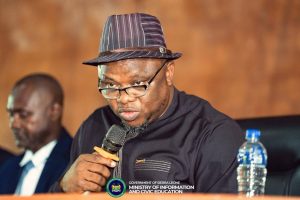
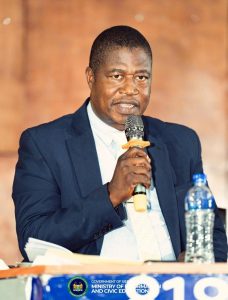
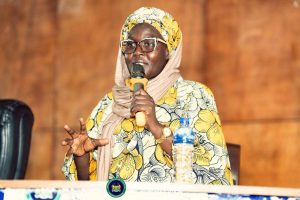
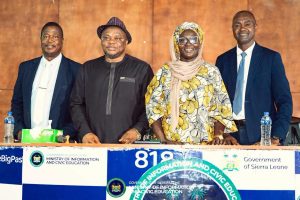
The Ongoing National Conversation, held at Westminster Chapel, Buckingham Gate, London, and hosted by the Minister of Information and Civic Education, Chernor Bah. The event featured Vice President Dr. Mohamed Juldeh Jalloh and brought together members of the Sierra Leonean diaspora to engage with government officials on key national development issues.
Speaking on one of the most frequently raised concerns among Sierra Leoneans abroad, Minister of Lands, Housing and Country Planning, Dr. Turad Senesie, acknowledged that land ownership and administration have historically posed significant challenges in Sierra Leone.
“The land sector has been one of the most chaotic sectors in Sierra Leone for many years,” Dr. Senesie said. “At one point, over 70 percent of court cases were land related. Through ongoing reforms, that figure has now reduced to approximately 35 percent, but we remain committed to reducing it even further.”
The Minister attributed many of the challenges to overlapping and conflicting land laws that existed prior to the government’s reform agenda. He explained that laws governing state lands, unoccupied lands and customary lands often contradicted one another, creating confusion and disputes.
To address these challenges, the government has undertaken a comprehensive review of land legislation aimed at harmonising the legal framework, improving land governance and creating a more conducive environment for investment.
Dr. Senesie further disclosed that government is actively addressing fraudulent land transactions, particularly cases involving falsified ownership records and illegal sales of large parcels of land to unsuspecting investors, including members of the diaspora.
“We are reviewing policies and laws to reclaim improperly acquired lands and make them available for genuine development and investment purposes,” he stated.
A key achievement highlighted by the Minister was the enactment of the Customary Land Rights Act 2022, which has significantly expanded access to land ownership across Sierra Leone.
According to Dr. Senesie, the legislation guarantees women the right to own, access and inherit land, ending long-standing discriminatory practices that denied women inheritance rights in many communities.
“The President made it clear that women should not be excluded from inheriting family property simply because they are married. Today, women have legal rights to inherit and own property under the law,” he said.
The Minister also noted that the Act has removed restrictions that previously prevented Creoles from owning customary land in the provinces.
“Today, all Sierra Leoneans have equal rights to access and own land regardless of their region or ethnic background. This reflects the vision of His Excellency President Julius Maada Bio for a more inclusive nation,” he added.
On the issue of land documentation, Dr. Senesie explained that many Sierra Leoneans mistakenly believe that a conveyance document constitutes legal title to land.
“A conveyance is merely evidence of a transaction; it is not proof of ownership. Sierra Leone is now transitioning to a proper title registration system that will provide greater security and certainty for landowners,” he explained.
The Minister highlighted the establishment of the National Land Commission, which will oversee the country’s transition to a modern title registration system. He revealed that advanced digital technologies are being deployed to improve land administration, including an online portal that will allow individuals anywhere in the world to verify ownership records and trace the history of land transactions.
“Someone in London will be able to verify ownership of a property in Sierra Leone through a digital platform and see the chain of ownership from the original owner to the present holder,” he said.
To further address boundary disputes and overlapping surveys, the government has introduced modern geospatial technologies, including drone mapping and Continuous Operating Reference Stations (CORS), which are expected to improve the accuracy of land surveys nationwide.