By: Marian Magdalene Bangura
Strategic Communication Unit,
Ministry of Information and Civic Education

Freetown, Sierra Leone, Tuesday, 2 September 2025-Civil society has praised the Government of Sierra Leone’s Free Quality Education (FQE) Program, citing its transformative impact on girls’ education and alignment with the country’s broader development agenda.
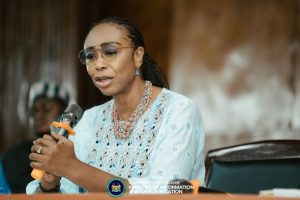
Speaking at the government weekly press briefing held at the Miatta Conference Centre, the CEO of Moving Women for Sustainable Development and First Lady of the Baptist Convention, Mrs. Mariama Khai Fornah highlighted the far-reaching benefits of FQE, describing it as a “visionary initiative that is breaking barriers for girls and ensuring no child is left behind.”
On Enrollment Growth, Citing the IMF 2024 Country Report and government data, Mrs. Fornah noted that girls’ school enrollment has more than doubled since the program’s launch in 2018: Primary school, 119.9% in 2017 – 162.0% in 2022, Junior secondary school, 55.9% in 2017 – 110.0% in 2022, and for Senior secondary school, 25.0% in 2017 – 90.0% in 2022. “These results speak volumes. In just five years, opportunities for girls to access education have expanded dramatically,” she said.
On Infrastructure and Policy Reforms, she also noted that the FQE program has been supported by investments in new schools and expanded facilities, including Baptist schools in Bendembu and Makeni, as well as additional classrooms at St. Joseph’s Secondary School in Freetown to reduce the double-shift system.
Key policy milestones include the Radical Inclusion Policy (2021), which lifted the ban on pregnant girls attending school, increasing enrollment from 915 in 2020 to 1,289 in 2022. Other initiatives include, the school feeding program, which boosts attendance and supports both pupils and teachers, Provision of free textbooks and exercise books, easing the financial burden on parents, also Support for formerly private schools to transition into the public system for wider access.
On Social Impact and Empowerment, Mrs. Fornah stressed that FQE has not only increased access but also shifted gender dynamics in education. “Before, boys often outperformed girls in classrooms. Today, girls are leading the charts, scoring top results across many schools. Parents now believe more strongly in the potential of their daughters,” she noted.
She further emphasized the alignment of FQE with Sierra Leone’s Medium-Term National Development Plan (2024–2030) and the Sustainable Development Goals (SDG 4: Quality Education and SDG 5: Gender Equality).
She stressed on a call for collective action and urged all stakeholders to remain committed despite ongoing challenges. “If government, parents, teachers, civil society, and the media continue to work together, Sierra Leone will see a brighter future for the girl child. Free quality education is not just a policy. It is an investment in tomorrow’s leaders.” She concluded.