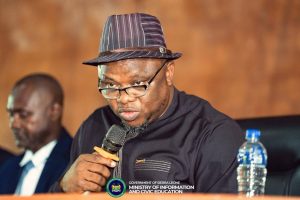
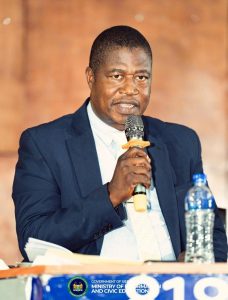
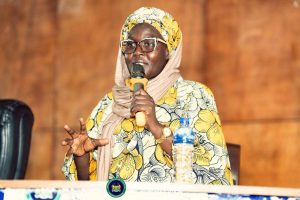
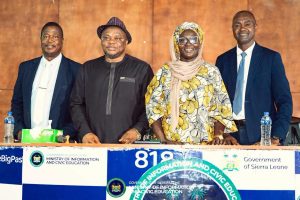
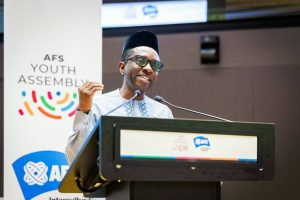
Dr. Kandeh Kolleh Yumkella, Energy Sector Lead and Chairman of Sierra Leone’s Presidential Initiative on Climate Change, Renewable Energy and Food Security, delivered an update on the nation’s ambitious energy plan, Mission 300, the $2.2 Billion Compact, during the weekly press conference organized by the Ministry of Information and Civic Education on Tuesday, 7th October 2025.
Highlighting the recent endorsement by global partners, Dr. Yumkella emphasized the significance: “The President recently received full endorsement of Sierra Leone’s Mission 300 Energy Compact from the World Bank and development partners in New York. Remember, the other MCC took a long time because their own conditions are reviewed every year. So, this was a record time.” He noted that this swift approval underscores the government’s commitment to accelerating energy development and regional cooperation.
He underlined the importance of leveraging institutional knowledge, stating, “It’s not every day you get to reinvent the wheel. If you’re a good policy person, you go back to the institution and say, ‘What do you have, what studies have been done so you don’t unnecessarily reinvent the wheel?'” He mentioned that this approach has enabled the government to build on past efforts, backing them up with fresh analytics and combining existing studies to craft a viable plan within a remarkably short period.
The core of Mission 300 is to repair the country’s energy landscape. The plan envisions increasing the installed electricity capacity from 271 megawatts to over 1,000 megawatts, improving electrification rates from 36% to 78% and expanding renewable energy sources from 46% to nearly 52% over five years.
Dr. Yumkella pointed out that Mission 300 is the single biggest thing for electrification in Africa, highlighting its transformative potential. He added, “This is really about making power accessible for all, especially in rural areas.”
Public health concerns form a key part of this strategy. “About 90% of the population do not have access to clean cooking,” Dr. Yumkella explained. “We estimate it’s between 30,000 to 50,000 a year [affected], with women and children bearing the brunt of exposure to harmful charcoal and firewood.”
The ambitious initiative is built on five pillars: expanding generation capacity, regional energy integration, decentralizing renewable solutions like mini-grids and solar home systems, powering key social sectors such as health and education and reforming the utility to make it financially sustainable. On the challenge of reforming the utility sector, he stated, “With these investments, you do not make money in the first five years but after,” emphasizing the long-term outlook of the project.
Financially, the plan requires about $1.4 billion in investments. This includes roughly $600 million from independent power producers, plus funding set aside for generation, transmission, distribution, off-grid solutions, clean cooking facilities and capacity building. “This plan is not just Salone’s plan. It is backed by international players,” Dr. Yumkella said, citing the commitments from the World Bank, African Development Bank and regional partners like Tanzania. “With this money and the right policy reforms, the private sector will come in… That’s what we call de-risking and leverage,” he added.
He also shared an update on the MCC compact, which had faced a temporary cancellation, saying it has now been reintegrated into Sierra Leone’s broader energy strategy. “About a quarter of the money here is part of the MCC money. It’s an integrated plan,” he noted, emphasizing the synergy between the MCC and Mission 300 efforts.
Regional trade and cooperation remain vital, according to Dr Yumkella. “We may be buying from them now, but we will sell to them back again,” Dr. Yumkella said, echoing President Bio’s vision of Sierra Leone becoming a regional energy hub. Neighboring countries like Guinea and Cote d’Ivoire are sources of hydro and gas resources that Sierra Leone aims to leverage, fostering a regional market for power.
He concluded with a call for partnership and confidence: “It’s an investment plan. It’s not an aid plan. I’m very proud of the young technicians who did this, led by a woman. And the partners are confident.” With the focus now shifting toward actual deals and implementation, the country is ready to take bolder steps toward energy independence, economic growth and improved public health with aims definitely set for 2030.