By Mohamed Jaward Nyallay
Strategic Communications Adviser – Ministry of Information and Civic Education
Political legacies are rarely forged in moments of triumph. More often, they are defined by the choices leaders make when convention offers the safer path.
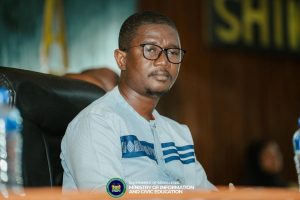
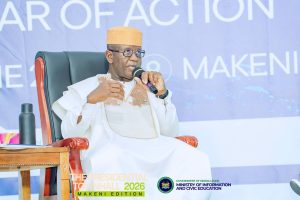
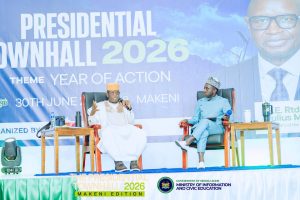
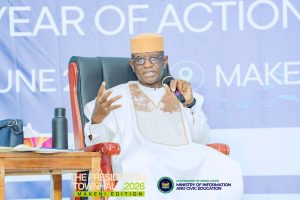
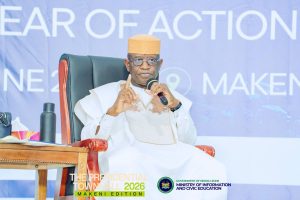
The Presidential Town Hall in Makeni may prove to be one of those moments.
For generations, Sierra Leone’s politics has been shaped by geography as much as ideology. Electoral maps have too often doubled as maps of political identity, with regions viewed less as communities of citizens than as partisan strongholds. Governments have governed within that reality, sometimes reinforcing it, sometimes attempting to soften it, but seldom challenging it head-on.
Makeni represented such a challenge.
So its time; time to tear the script apart, throw away the norm, rubbish the convention. Because a new democratic culture is born. A new standard is set. This will be the bar, the bar by which every other leader’s commitment to public engagement will be measured.
In choosing to hold a nationally televised town hall in a city widely regarded as the opposition’s political heartland, President Bio did more than fulfil a public engagement exercise. He made a strong statement about the meaning of political leadership in a democratic republic. This is a full circle moment, because this is a democracy he nurtured.
A President, after all, is not elected to govern only those who voted for him. The office demands stewardship over the entire nation, including its fiercest critics.
That principle sounds self-evident. In practice, it is remarkably rare, especially in Sierra Leone.
Nearly twenty-five centuries ago, citizens gathered on the Pnyx Hill in Athens to question their leaders in full public view. Democracy, at its purest, was built upon proximity between the governed and those who governed. Modern representative democracies have inevitably placed greater distance between citizens and political authority, but the town hall remains one of the few institutions that preserves that ancient democratic instinct—the willingness of leaders to submit themselves to public scrutiny.
The Makeni engagement drew from that tradition.
Its significance lay not in carefully prepared speeches or political messaging, but in its setting. The venue mattered because symbolism matters in politics. Democracies are sustained not only by constitutions and elections but by public rituals that reinforce shared national identity.
By travelling into an opposition stronghold—not for a campaign rally but for an open civic dialogue—the Presidency projected a simple but powerful message: no community exists outside the reach of government, and no citizen falls outside the circle of democratic conversation.
That may ultimately become the event’s most enduring contribution.
Politics often rewards leaders who speak to their supporters. Statesmanship demands the confidence to speak to sceptics.
Throughout the engagement, President Bio appeared comfortable doing precisely that.
There was no visible attempt to diminish uncomfortable questions or dismiss the frustrations expressed by some citizens. Instead, he acknowledged concerns, defended his government’s record and explained the reasoning behind policy decisions. There were moments of humour, moments of reflection and moments of disagreement, but remarkably little of the political theatre that frequently dominates public discourse.
The atmosphere itself revealed something important.
Confidence in leadership is often measured less by applause than by a willingness to face criticism without defensiveness. Leaders secure in their record generally invite questions; leaders uncertain of their record tend to avoid them.
The Presidential Town Hall suggested a Presidency prepared to put itself up for public scrutiny.
That confidence is rooted in a broader narrative President Bio has consistently advanced throughout his administration—that Sierra Leone is becoming more respected internationally and more ambitious domestically. Whether discussing democratic governance, education, gender equality or the country’s diplomatic standing, he returned repeatedly to a single idea: that Sierra Leone should aspire to compete not with its past, but with its potential.
This explains why the conversation frequently shifted from politics to legacy.
As every presidency enters its final chapter, attention naturally turns from governing to history. Leaders begin asking not merely what they have achieved, but what institutions and values will endure after they leave office.
President Bio appears increasingly conscious of that transition.
Only days before the Makeni Town Hall, he celebrated the graduation of one of his daughters. It was perhaps fitting, therefore, that one of the day’s most thoughtful questions came from a young female student asking what leadership had taught him.
His response was less about personal success than public responsibility.
That perspective has increasingly shaped his political language.
“We want to create a society that is inclusive. Wherever you are, whoever you are, we want to make sure you are part of society.”
The statement encapsulates an idea that runs through many of the administration’s major reforms: expanding access to education, strengthening opportunities for women, investing in young people and broadening participation in national development.
Whether one agrees with every policy is ultimately beside the point.
The more consequential question is whether Sierra Leone’s political culture itself is changing.
One of the most revealing moments came when President Bio urged citizens to move beyond identity politics.
“Scrutinize your future leaders. Don’t vote for colour. Let every political party present a message—a message that resonates with your future.”
For a country where electoral competition has frequently been interpreted through ethnic and regional lenses, this was an appeal to judge politics by ideas rather than inherited loyalties.
It is an ambitious proposition and also symbolic.
The symbolism becomes even more compelling when viewed against President Bio’s own political journey. Before assuming office in 2018, he endured years of intense political confrontations and sustained personal attacks; from politicians, to activists and journalists. Having gone through that, few leaders would have been faulted for retreating into partisan comfort. But he has not.
Instead, he chose to stand before one of the country’s most politically diverse audiences and engage them directly.
That decision reflects a broader philosophy: reconciliation is not achieved by asking citizens to forget political differences; it is achieved by demonstrating that those differences need not prevent conversation.
Ultimately, political legacies are not determined solely by roads built, schools opened or laws enacted. Those achievements matter profoundly, but they are only part of the historical record.
Equally important are the democratic norms leaders leave behind.
If future Presidents come to regard regular public engagement—even in politically difficult environments—not as an act of courage but as an ordinary obligation of office, then the Presidential Town Hall will have achieved something that extends well beyond one administration.
Its lasting contribution will not be measured by headlines or applause.
It will be measured by whether Sierra Leone’s democracy becomes more confident, more inclusive and more comfortable with the simple but demanding idea that leadership begins by listening.
That, perhaps, is the quiet legacy President Bio is seeking to leave behind.
Mohamed Jaward Nyallay is the Strategic Communications Adviser at the Ministry of Information and Civic Education. He is an award winning journalists and associate lecturer at Fourah Bay College.